

1. Description
Apache HTTP Server is one of the widely deployed web server platforms used to host websites, web applications, APIs, and enterprise services.
The vulnerability affects mod_http2, the Apache module responsible for supporting HTTP/2 communication.
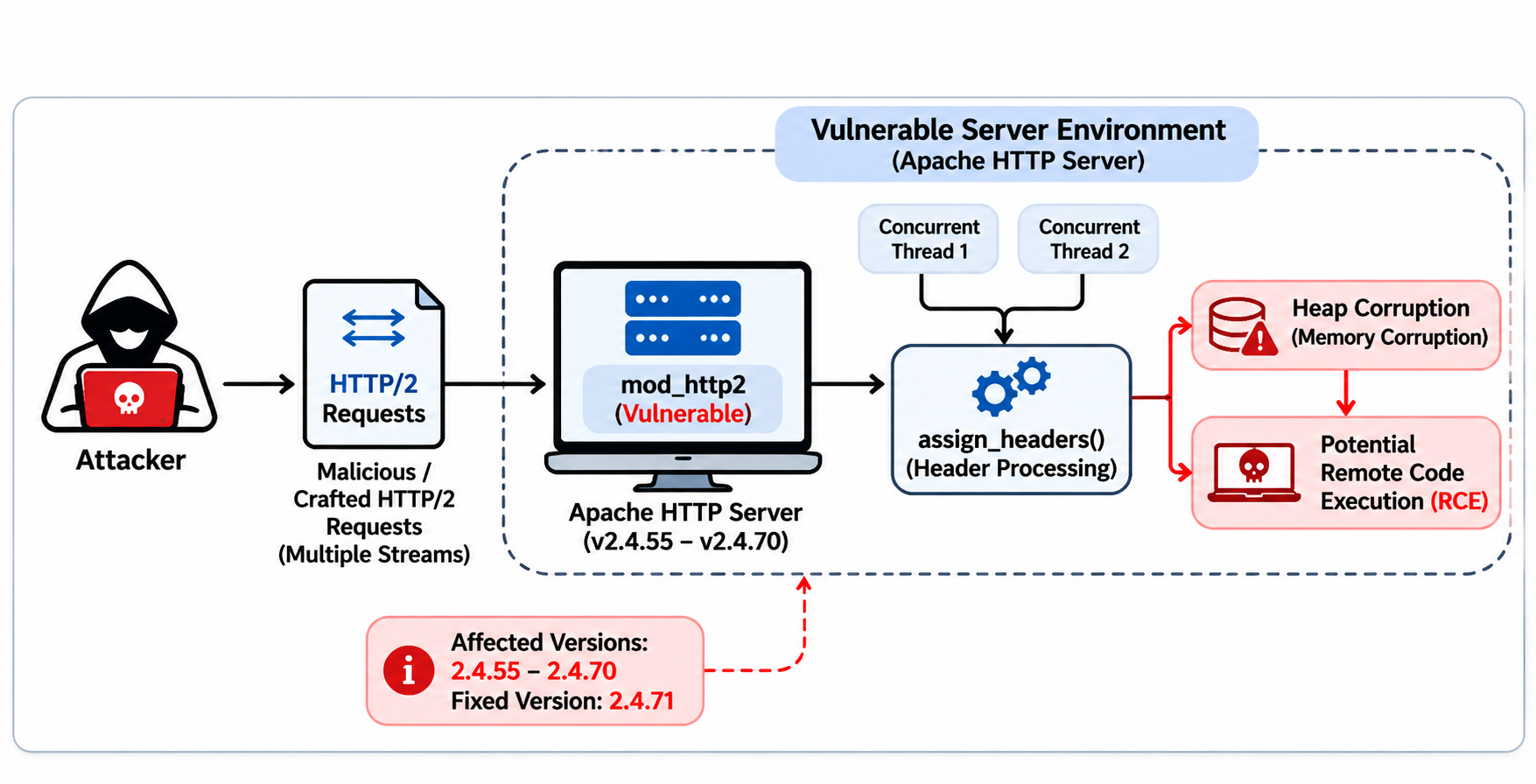
According to the Apache security advisory, CVE-2026-119618 is a Concurrent Execution using Shared Resource with Improper Synchronization vulnerability. The issue occurs in the assign_headers() function, where improper synchronization can lead to heap corruption and potentially remote code execution.
The vulnerability affects Apache HTTP Server versions from 2.4.55 through 2.4.70.
The Apache project addressed the issue in version 2.4.71, released on November 11, 2026. The advisory also identifies affected releases of the separately distributed mod_h2 project from version 2.0.8 through 2.0.42.
2. Technical Description
CVE-2026-119618 – Heap Corruption and Remote Code Execution in mod_http2
Affected Product: Apache HTTP Server
Affected Component:
mod_http2Affected Function:
assign_headers()CVE ID: CVE-2026-119618
Severity: Critical
Vulnerability Type: Improper Synchronization / Concurrent Execution
Potential Impact: Heap Corruption and Remote Code Execution
Affected Versions: 2.4.55 through 2.4.70
Fixed Version: Apache HTTP Server 2.4.71
Fixed Release Date: November 11, 2026
Related Project:
mod_h2versions 2.0.8 through 2.0.42
The vulnerability is associated with improper synchronization when concurrent execution accesses a shared resource within the HTTP/2 header-assignment process.
When multiple execution paths interact with shared memory without appropriate synchronization, the application may enter an unsafe memory state.
In this case, the Apache advisory identifies heap corruption and potential remote code execution as the consequences.
The issue was fixed in the Apache HTTP Server 2.4.x source tree through commit 824beab on November 11, 2026.
3. Vulnerability Overview
CVE-2026-119618 affects the internal processing of HTTP/2 headers in Apache HTTP Server.
HTTP/2 allows multiple streams to be processed over a single connection. This improves communication efficiency by allowing requests and responses to be handled concurrently.
The vulnerability involves improper synchronization when shared resources are accessed during header assignment.
The Apache advisory identifies the following details:
Attribute | Details |
|---|---|
Vulnerability | CVE-2026-119618 |
Affected module |
|
Vulnerable function |
|
Root cause | Improper synchronization |
Memory impact | Heap corruption |
Potential consequence | Remote Code Execution |
Severity | Critical |
Fixed release | 2.4.71 |
The vulnerability was reported independently by:
Anthropic's Open Source Scanner, under identifier
ANT-2026-MAPKT6MZ.Anthony Weems and Simon Scannell of Google Cloud Vulnerability Research.
Anthropic reported the issue to the Apache security team on October 26, 2026, followed by Google's report on November 3, 2026.
4. Technical Analysis
1. Understanding the mod_http2 Module
mod_http2 is responsible for implementing HTTP/2 protocol support in Apache HTTP Server.
HTTP/2 introduces features such as multiplexing, which allows multiple independent streams to share a single connection.
Unlike traditional HTTP/1.1 request handling, HTTP/2 supports concurrent stream processing. This requires careful management of shared resources and synchronization between execution paths.
The vulnerability identified in CVE-2026-119618 affects this internal processing.
2. Improper Synchronization
The root cause is classified as Concurrent Execution using Shared Resource with Improper Synchronization.
This type of weakness occurs when multiple execution paths access or modify a shared resource without sufficient coordination.
If one execution path changes a shared resource while another is accessing it, the application may process inconsistent or unexpected data.
In Apache's case, the vulnerable operation occurs in the assign_headers() function of mod_http2.
The security advisory identifies heap corruption as a possible consequence of this synchronization issue.
3. Heap Corruption
The heap is a region of memory used by applications for dynamically allocated data.
Heap corruption occurs when an application incorrectly modifies or accesses memory allocated in this region.
Depending on the nature of the corruption, it may result in:
Application crashes.
Unexpected application behavior.
Memory integrity violations.
Potential execution of attacker-controlled code.
Apache identifies remote code execution as a potential impact of this vulnerability. However, the public advisory does not provide a complete exploit chain or demonstrate the precise memory manipulation required to achieve code execution.
4. Potential Remote Code Execution
The most serious concern is the potential for remote code execution.
If an attacker can successfully trigger the vulnerable condition and control the resulting memory corruption, it may create an opportunity to execute unauthorized code within the affected server process.
Depending on the privileges assigned to the Apache service, successful exploitation could potentially expose server resources and hosted applications.
However, the Apache advisory does not publish a confirmed public exploit or establish the exact prerequisites for successful exploitation. Therefore, remote code execution should be described as the documented potential impact, not as a demonstrated attack scenario.
5. Attack Overview
The following describes a conceptual attack scenario based on the vulnerability's documented behavior. It is not a confirmed exploitation sequence.
1. Identification of Vulnerable Servers
An attacker identifies an Apache HTTP Server deployment running an affected version between 2.4.55 and 2.4.70.
The presence of mod_http2 and the relevant configuration would need to be assessed.
2. HTTP/2 Request Processing
The attacker sends network requests to the affected server.
The requests reach the HTTP/2 processing component, where header assignment is handled by the vulnerable assign_headers() function.
3. Concurrent Execution
Under the relevant conditions, concurrent execution may cause multiple processing paths to access a shared resource without proper synchronization.
This can result in an inconsistent memory state.
4. Heap Corruption
The synchronization weakness may lead to heap corruption within the Apache HTTP Server process.
The resulting behavior could include memory corruption or a server crash.
5. Potential Code Execution
If the memory corruption can be reliably controlled and the necessary exploitation conditions are met, it may potentially lead to remote code execution.
The actual exploitability depends on factors such as process protections, execution environment, and the ability to trigger and control the vulnerable condition.
Important: Apache's published advisory does not provide a complete proof-of-concept, exploit code, or confirmed real-world attack sequence. The stages above explain the potential vulnerability behavior rather than claiming that attackers have successfully performed each step.
6. Potential Impact
Successful exploitation of CVE-2026-119618 could create serious security risks for organizations operating affected Apache HTTP Server deployments.
Remote Code Execution: Successful exploitation may allow unauthorized code execution within the affected server process.
Server Compromise: An attacker who achieves code execution could potentially compromise the web server, depending on the privileges available to the Apache process.
Service Disruption: Heap corruption may cause application instability, unexpected crashes, or denial of service.
Data Exposure: If server-level access is obtained, hosted application data and accessible configuration information could be exposed.
Application Security Risks: A compromised web server may provide an attacker with opportunities to target connected applications and backend services.
The actual impact depends on the affected version, deployment configuration, service privileges, and additional security protections.
7. Recommendations
Immediate Actions
Upgrade Apache HTTP Server: Upgrade affected installations to Apache HTTP Server 2.4.71, which contains the fix for CVE-2026-119618.
Identify Vulnerable Deployments: Check all Apache installations running versions 2.4.55 through 2.4.70.
Review mod_http2 Usage: Identify systems using the affected HTTP/2 module and review their configurations.
Check Separately Distributed mod_h2: Organizations using the standalone mod_h2 project should review versions 2.0.8 through 2.0.42 and apply the appropriate fixed release.
Review Server Logs: Investigate unexpected HTTP/2 processing errors, worker crashes, and abnormal request activity.
Assess Exposure: Prioritize internet-facing Apache servers and critical applications running affected versions.
Preventive Actions
Maintain Regular Patch Management: Establish a process for monitoring Apache security advisories and applying updates promptly.
Apply Least Privilege: Run Apache services with restricted permissions to reduce the potential impact of successful exploitation.
Monitor Web Server Behavior: Use centralized logging and security monitoring to identify unusual request patterns, process activity, and server crashes.
Implement Network Security Controls: Apply appropriate firewall rules and network segmentation to protect web server infrastructure.
Conduct Vulnerability Assessments: Regularly assess Apache installations, enabled modules, and configurations for known security weaknesses.
Maintain Incident Response Readiness: Prepare procedures for isolating affected servers, collecting forensic evidence, and restoring trusted services.
8. Conclusion
CVE-2026-119618 highlights the security risks associated with improper synchronization in multi-threaded application environments.
The vulnerability affects Apache HTTP Server's mod_http2 module and can result in heap corruption and potentially remote code execution.
Because Apache HTTP Server is widely used to host websites, APIs, and enterprise applications, vulnerable deployments may represent an important security concern.
The release of Apache HTTP Server 2.4.71 addresses the issue. Organizations should identify affected installations, upgrade to the fixed version, and monitor their web server environments for unusual activity.
This vulnerability also reinforces the importance of securing protocol-handling components, particularly those responsible for processing concurrent network requests and managing shared memory resources.