

1. Description
Microsoft's November 2026 Patch Tuesday addresses security vulnerabilities affecting multiple products, including Windows, Microsoft Office, SQL Server, SharePoint Server, Exchange Server, Azure, and developer tools.
The release is particularly important because it includes an actively exploited vulnerability in Microsoft Outlook.
Tracked as CVE-2026-124194, the vulnerability exists because Outlook does not properly warn users before performing an unsafe action involving an external network location.
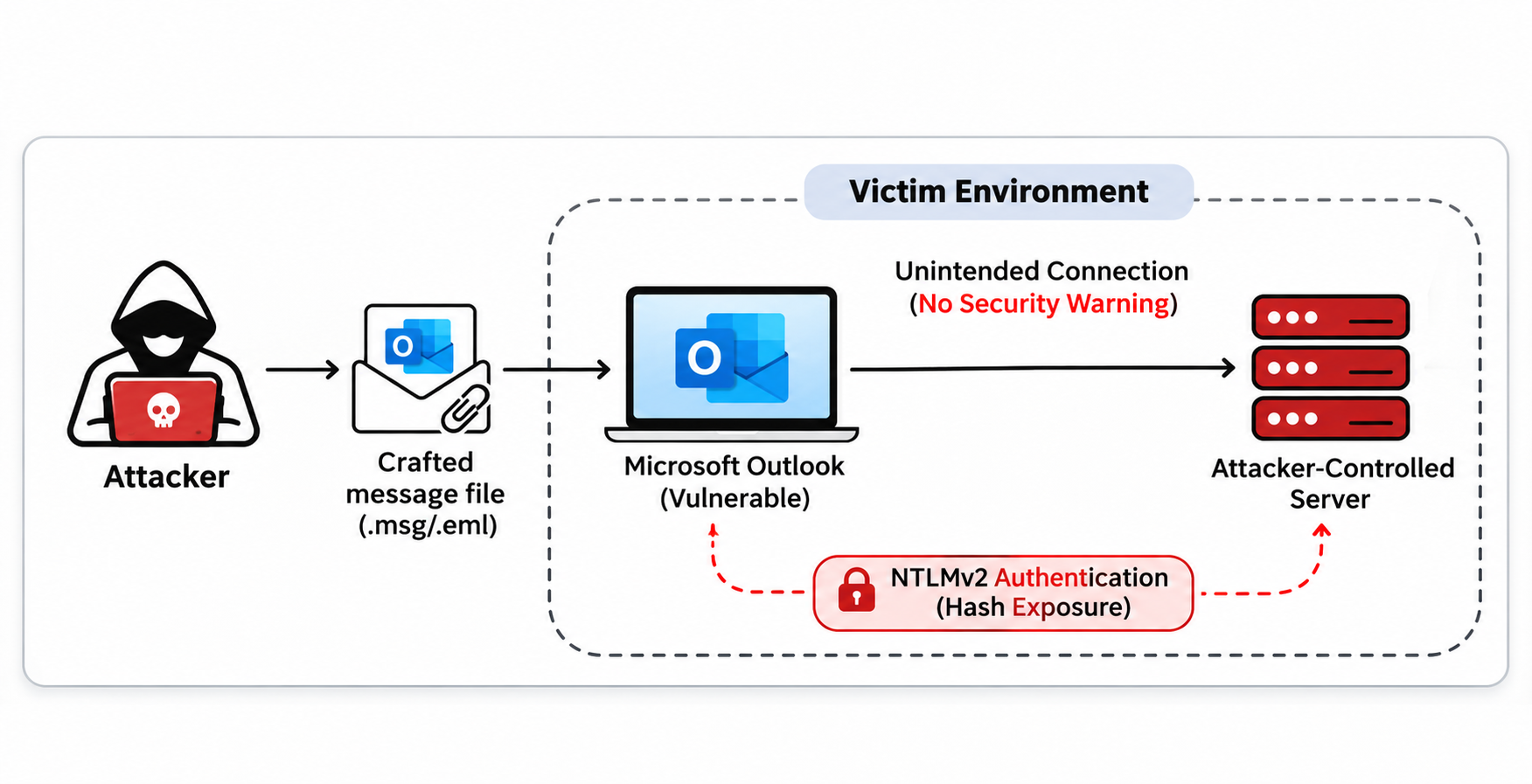
An attacker could send a specially crafted message file to a target and convince the recipient to open it. This may cause Outlook to connect to an attacker-controlled server without displaying the usual external-content security warning.
As a result, authentication information could be disclosed to the attacker.
Microsoft has confirmed exploitation of this vulnerability before the November security updates became available. However, the company has not publicly attributed the attacks to a particular threat actor or disclosed the extent of exploitation.
2. Technical Description
CVE-2026-124194 – Microsoft Outlook Spoofing Vulnerability
Affected Product: Microsoft Office Outlook.
CVE ID: CVE-2026-124194.
CVSS Score: 6.5.
Severity: Moderate.
Vulnerability Type: Spoofing.
CWE: CWE-356 – Product UI Does Not Warn User of Unsafe Actions.
Exploitation Status: Confirmed exploited in the wild.
Patch Release: November 10, 2026.
The vulnerability is related to how Microsoft Outlook handles specially crafted message files and external network connections.
An unauthenticated attacker can send a malicious message file to a potential victim. If the victim opens the file in an affected version of Outlook, the application may connect to an attacker-controlled network location without displaying its normal external-content warning.
This connection could expose authentication information, including an NTLMv2 hash.
NTLMv2 is an authentication protocol used in Windows environments. Although the captured hash is not the user's plaintext password, it may provide an attacker with material for offline password-cracking attempts or other authentication-related attacks.
The vulnerability requires network connectivity and user interaction. It does not mean that simply receiving an email automatically compromises the recipient's account.
3. Attack Overview
The reported exploitation involves abusing Outlook's handling of a specially crafted message file to initiate an unexpected connection to an attacker-controlled network location.
The attack can be understood through the following stages.
1. Malicious Message Delivery
The attacker sends a specially crafted message file to the intended victim.
The attack does not require the attacker to authenticate to the victim's Outlook environment, according to the published vulnerability description.
2. User Interaction
The victim is persuaded to open the specially crafted message file in an affected version of Outlook.
User interaction is required for the reported exploitation scenario.
3. External Connection Initiation
When the file is opened, Outlook may initiate a connection to an attacker-controlled network location without displaying the usual external-content security warning.
This behavior is central to the vulnerability.
4. Authentication Information Exposure
The connection may disclose authentication information, including the user's NTLMv2 hash.
The attacker could potentially use the captured authentication material in further attempts to impersonate the affected user.
5. Potential Follow-on Attacks
Depending on the privileges of the affected account and the surrounding network configuration, exposed authentication material could increase the risk of unauthorized access to organizational resources.
Microsoft has confirmed exploitation but has not published detailed information about the complete attack chain, the identity of the attackers, or the number of affected organizations.
4. Technical Analysis
The main security concern with CVE-2026-124194 is the possibility of exposing authentication information through an unexpected network connection.
NTLMv2 Authentication Exposure
NTLMv2 is a challenge-response authentication mechanism used in Windows environments.
When a system attempts to authenticate to a remote service, authentication-related information is exchanged as part of the protocol.
In this vulnerability, Outlook may connect to an attacker-controlled location without displaying the expected security warning.
This could expose an NTLMv2 hash to the remote destination.
If an attacker obtains the hash, it may be used in offline password-cracking attempts or other authentication attacks, depending on the circumstances.
Why the Moderate Severity Rating Matters
Microsoft assigned the vulnerability a CVSS score of 6.5, placing it in the Moderate severity category.
However, the severity score should not be the only factor considered during security prioritization.
The vulnerability is particularly important because:
Microsoft confirmed that it was exploited in the wild.
The attack can expose authentication information.
It affects Outlook, which is widely deployed in enterprise environments.
User interaction is required, meaning awareness and email security controls remain important.
This demonstrates why organizations should consider exploitation status, affected systems, and business exposure alongside CVSS scores when prioritizing security updates.
Additional Critical Vulnerabilities
The November release also addresses several critical vulnerabilities across Microsoft's software portfolio.
CVE ID | Affected component | Vulnerability type | CVSS |
|---|---|---|---|
CVE-2026-109469 | Microsoft Entra Device Registration | Elevation of Privilege | 10.0 |
CVE-2026-112967 | Windows Xbox Live Networking Service | Remote Code Execution | 9.8 |
CVE-2026-116928 | Windows Search | Remote Code Execution | 9.8 |
CVE-2026-119958 | Windows LDAP | Remote Code Execution | 9.8 |
CVE-2026-119990 | Azure OpenAI | Elevation of Privilege | 9.8 |
CVE-2026-121126 | Chromium | Use After Free | 9.6 |
These vulnerabilities demonstrate that the November update is not limited to Outlook. It also addresses security issues affecting Windows services, identity infrastructure, cloud services, and other components.
Organizations should consult the corresponding Microsoft Security Update Guide entries to identify affected versions and applicable fixes.
5. Potential Impact
Successful exploitation of CVE-2026-124194 could create authentication and security risks for individuals and organizations using affected Outlook versions.
Authentication Information Exposure: An attacker may obtain NTLMv2 authentication hashes through an unexpected external connection.
Credential Abuse: Captured authentication material could potentially support password-cracking attempts or other authentication-related attacks.
Unauthorized Access: If the attacker successfully abuses exposed authentication material, organizational accounts and resources may become accessible.
Enterprise Network Risk: Compromised credentials could increase the possibility of further attacks against internal systems, depending on account privileges and network security controls.
Business and Data Exposure: Unauthorized access to employee accounts could expose emails, business communications, and other sensitive organizational information.
The actual impact depends on the affected account, authentication configuration, network exposure, and additional security controls.
6. Recommendations
Immediate Actions
1. Apply Microsoft Security Updates: Install the November 2026 security updates for affected Microsoft products, prioritizing Outlook and the actively exploited vulnerability CVE-2026-124194.
2. Review Outlook Versions: Identify systems running affected Outlook versions and confirm that the applicable security updates have been installed.
3. Monitor Outbound Connections: Investigate unusual external network connections initiated by Outlook, particularly following the opening of suspicious message files.
4. Review NTLM Authentication Activity: Monitor unexpected NTLM authentication attempts involving external destinations.
5. Investigate Suspicious Emails: Review unusual message files and attachments received by employees, particularly those requesting immediate action.
6. Protect Potentially Exposed Accounts: If authentication information is suspected to have been exposed, investigate the affected account and follow credential-reset and incident-response procedures.
7. Prioritize Other Critical Vulnerabilities: Review the November security bulletin for critical vulnerabilities affecting Windows, Entra, Azure, and other deployed products.
Preventive Actions
1. Restrict Outbound NTLM Authentication: Apply appropriate network and authentication policies to prevent unnecessary NTLM authentication to untrusted external destinations.
2. Strengthen Email Security: Use attachment scanning, phishing protection, and email filtering to identify suspicious message files.
3. Implement Multi-Factor Authentication: Enforce MFA for important organizational accounts to reduce the risk associated with compromised authentication credentials.
4. Monitor Authentication Events: Centralize authentication logs and investigate unusual NTLM activity, repeated authentication failures, and unexpected external connections.
5. Maintain Patch Management: Establish a regular security update process and prioritize vulnerabilities confirmed to be exploited in the wild.
6. Apply Least Privilege: Restrict administrative privileges and ensure that user accounts have only the permissions required for their responsibilities.
7. Conduct Security Awareness Training: Educate employees about suspicious attachments, unexpected message files, phishing techniques, and the risks of opening untrusted content.
8. Review Legacy Authentication: Identify where NTLM is still required and evaluate opportunities to reduce its use in favor of stronger authentication mechanisms.
7. Conclusion
Microsoft's November 2026 Patch Tuesday highlights the importance of timely security updates across enterprise environments.
Although the release addresses numerous critical vulnerabilities, CVE-2026-124194 deserves particular attention because Microsoft confirmed that it was actively exploited before the patch became available.
The Outlook vulnerability demonstrates how an apparently simple user interaction can trigger an unexpected external connection and potentially expose authentication information.
For organizations, the priority should be to install the relevant security updates, investigate suspicious Outlook network activity, monitor NTLM authentication, and strengthen email and identity security controls.
The incident also reinforces an important lesson for security teams: vulnerability prioritization should consider real-world exploitation and potential business impact, not just the numerical severity rating.