

Technical Description
The campaign combines remote code execution against vulnerable Check Point Mobile Access portals with local privilege escalation on the underlying Gaia operating system.
Vulnerability Overview
CVE | Description | CVSS | Role in the attack |
|---|---|---|---|
CVE-2026-109618 | PHP2Shell remote code execution vulnerability | 9.2 | Initial access |
CVE-2026-109619 | PHP2Shell remote code execution vulnerability | 9.2 | Initial access |
CVE-2026-123039 | Gaia OS DynamicCLI local privilege escalation | 7.8 | Root privilege escalation |
The PHP2Shell vulnerabilities allow unauthenticated remote code execution through vulnerable PHP interfaces exposed by Check Point Mobile Access portals.
CVE-2026-123039 affects the DynamicCLI IPC interface. Attackers who have already obtained local code execution can exploit this issue to execute commands with root privileges.
Important: CVE-2026-123039 is a local privilege-escalation vulnerability, not a standalone unauthenticated remote-access vulnerability. The observed campaign chained it after PHP2Shell exploitation.
Affected Products and Versions
According to Check Point's security advisory:
Check Point Security Gateways with Mobile Access Portal.
Security Gateway releases from R80 through R82.20.
Spark Firewalls running R81.10.x, R82.00.x, R77.20.x and R80.20.x are also listed in the PHP2Shell advisory.
CVE-2026-123039 affects Gaia releases R81.20, R82, R82.10 and R82.20.
Check Point's advisory provides separate vulnerability and remediation guidance for these products. Organizations should verify their exact release and installed hotfix against the relevant vendor security advisories.
Attack Overview
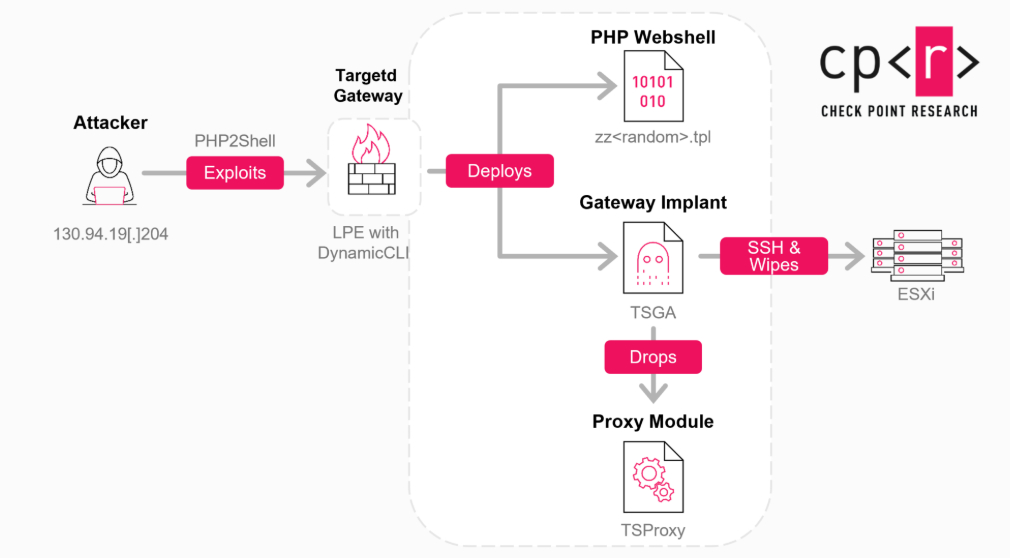
The observed attack chain consists of initial exploitation, privilege escalation, webshell deployment, persistence, internal reconnaissance, lateral movement, and destructive activity.
1. Initial Access – PHP2Shell Exploitation
Beginning October 30, attackers targeted internet-facing Check Point Mobile Access portals.
The investigation identified PHP session artifacts under:
/opt/CPcvpn-R81.20/tmp/
Session files containing the marker upload_progress_pwn were associated with the exploitation activity.
During the same period, Apache/PHP worker processes experienced hundreds of segmentation faults, providing additional evidence of repeated exploitation attempts.
The observed activity was consistent with exploitation of CVE-2026-109618 and CVE-2026-109619.
2. Privilege Escalation – CVE-2026-123039
After obtaining access through the Mobile Access portal, attackers exploited the Gaia DynamicCLI IPC interface.
The vulnerability enabled attackers to escalate privileges from the portal service account to root.
This provided the permissions necessary to deploy additional malware, modify appliance files, and establish persistent access.
3. PHP Webshell Deployment
Attackers deployed PHP webshells inside the Mobile Access portal's template directory.
The initial webshells followed the naming pattern:
zz*.tpl
The attackers subsequently replaced the initial lightweight shells with expanded versions.
The expanded webshell supported:
Operating-system command execution.
PHP code execution.
File uploads.
Plain-text command input.
Base64-encoded and XOR-obfuscated commands.
The expanded shell required the hardcoded key:
zz2026
Uploaded files were initially stored at:
/tmp/.up.tpl
The attackers subsequently copied the uploaded file into the portal's template directory as:
challenge_render.tpl
4. Persistent Backdoor Deployment – TSGA
Attackers deployed a Linux backdoor identified as TSGA.
The initial executable was launched from:
/tmp/CPconfigdaemon
It was executed in the background with output redirected to:
/tmp/.bd.log
When executed with root privileges, the malware relocated itself and relaunched under the name:
slot_CPconfigdaemon
The implant provides capabilities including:
Encrypted remote access.
Interactive command execution.
Configuration collection and theft.
Backup and snapshot-based persistence.
Process injection.
Binary firewall-log tampering.
File transfers.
These capabilities provide attackers with continued access to compromised Check Point appliances.
5. Network Persistence and Concealed Communications – TSProxy
TSGA contains a second component identified as TSProxy.
The malware writes a shared library to:
/lib/libcpfwcommon.so
TSProxy is an embedded Linux networking backdoor that supports encrypted SOCKS-style proxying.
It can inject its shared library into selected appliance processes and intercept networking functions to handle specially marked attacker connections while allowing normal traffic to continue.
This provides a mechanism for concealing attacker communications within existing appliance services.
6. Internal Reconnaissance and Lateral Movement
After establishing persistence on the gateway, attackers deployed the gogo scanner to identify internal assets and services.
They subsequently moved laterally to a VMware ESXi host over SSH, authenticating with the vpxuser service account.
This demonstrates how a compromised perimeter security appliance can become a pivot point for accessing internal virtualization infrastructure.
7. Destructive Activity – destroy_v6 Wiper
During the first campaign wave, attackers deployed a Linux ELF wiper identified as:
destroy_v6
The malware was staged on the ESXi host at:
/tmp/des
Its capabilities include:
Recursive directory traversal.
Deletion of files regardless of extension.
Overwriting files with zeros before deletion by default.
Selective exclusion of directories through the
-woption.Fast deletion using the
-foption.Dropping politically themed notes named
DREAM_ANNEXATION.txt.
The notes explicitly reject ransom negotiations.
The second wave on November 2 expanded internationally, but Check Point reported no evidence of destructive activity during that wave.
Technical Analysis
Malware Components
Component | Description | Purpose |
|---|---|---|
PHP webshell | Malicious | Remote command execution and file uploads |
TSGA |
| Persistent gateway backdoor |
TSProxy |
| Concealed encrypted network access and proxying |
gogo | Internal scanner | Network reconnaissance |
destroy_v6 | Linux ELF wiper | File overwriting and deletion |
DREAM_ANNEXATION.txt | Destructive activity note | Political messaging accompanying the wiper |
PhiliKit Relationship
Check Point Research identified code, configuration, and cryptographic similarities between TSGA, TSProxy, and the previously documented PhiliKit malware framework.
The research identifies shared tooling characteristics, including:
Common Tiny SHell roots.
Encrypted remote-control communications.
TCP port 11072.
Unix socket
/tmp/.p_sock.Similar operator credentials and transport secrets.
Matching TLS certificate and private-key material between TSProxy and the PhiliKit-related networking component.
These similarities support a shared tooling lineage.
However, shared malware components do not independently establish who conducted this operation.
Threat Actor Attribution
Check Point Research identified links between the deployed implants and the PhiliKit malware family, which has previously been associated with the China-nexus threat actor UNC5221.
Additional contextual observations include:
Infrastructure hosted on LightNode VPS services.
Scanning activity concentrated between 00:00 and 09:00 UTC.
Similarities with tooling previously observed in attacks against Ivanti appliances.
However, researchers highlighted several inconsistencies with known Chinese-nexus operational patterns:
Destructive activity against Israeli organizations.
Politically themed notes referencing the Israeli-Palestinian conflict.
The use of the name PhiliKit, derived from the malware's internal name
philistine.
Check Point could not confidently determine the true nature of the operation.
Possible scenarios include direct operation by the identified actor, participation by an initial-access broker, or a false-flag operation.
Attribution assessment: Unconfirmed. Do not attribute the campaign directly to UNC5221 based solely on the identified tooling similarities.
Indicators of Compromise (IOCs)
The following indicators were published by Check Point Research.
File Hashes – SHA-256
SHA-256 | Associated file |
|---|---|
| TPL webshell |
| slot_CPconfigdaemon |
| CPconfigdaemon |
| gogo |
| destroy_v6 |
| DREAM_ANNEXATION.txt |
| philistine |
| libdssafe.so |
Network Indicators
Indicator | Type |
|---|---|
| Attacker infrastructure |
| Attacker infrastructure |
Additional Host-Based Indicators
Indicator | Description |
|---|---|
| PHP session artifact associated with exploitation |
| Webshell filename pattern |
| Observed webshell-related filename |
| Webshell upload staging path |
| Initial TSGA executable path |
| Persistent TSGA filename |
| TSGA output log |
| TSProxy shared library |
| Unix socket used for encrypted communications |
| Observed wiper staging path |
| Destructive activity note |
IOC handling note: Validate file hashes and infrastructure indicators against the original Check Point research before operational deployment. The IP addresses are published indicators associated with the campaign; their presence alone does not prove compromise.
Potential Impact
Successful exploitation of this attack chain can result in:
Unauthorized root-level access to Check Point Security Gateways.
Persistent compromise of perimeter security infrastructure.
Concealed remote access and proxy-based communications.
Exposure of gateway configuration and security-related information.
Internal network reconnaissance and lateral movement.
Unauthorized access to VMware ESXi infrastructure.
Destructive file overwriting and deletion.
Disruption of critical business services and virtualization environments.
Reduced forensic visibility through firewall-log tampering.
Recommendations
Immediate Actions
Apply vendor hotfixes: Install the November Check Point Jumbo Hotfix on all applicable Security Gateways and Management Servers as recommended by Check Point.
Verify PHP2Shell remediation: Confirm that the PHP2Shell fixes for CVE-2026-109618 and CVE-2026-109619 are installed.
Address privilege escalation: Verify remediation for CVE-2026-123039 on applicable Gaia releases.
Review Mobile Access portals: Prioritize internet-facing gateways and confirm their exact software versions and hotfix status.
Hunt for published IOCs: Search gateway files, logs, session artifacts, and relevant telemetry for the published hashes, IPs, filenames, and paths.
Inspect webshell activity: Investigate unexpected
.tplfiles, especially those matchingzz*.tpl, and review the portal template directory.Investigate backdoor persistence: Look for
slot_CPconfigdaemon,/lib/libcpfwcommon.so, and suspicious processes or shared-library injections.Review DynamicCLI activity: Investigate unexpected commands and suspicious local activity associated with CVE-2026-123039.
Investigate lateral movement: Review SSH activity involving VMware ESXi hosts and the
vpxuseraccount.Protect virtualization infrastructure: Validate ESXi host integrity, investigate unexpected file deletion, and ensure recoverable offline backups are available.
Escalate suspected compromise: Isolate affected appliances and engage Check Point Incident Response or qualified incident responders. Preserve evidence before rebuilding or cleaning systems.
Preventive Actions
Restrict administrative and Mobile Access interfaces to trusted networks wherever operationally possible.
Maintain a formal patch-management process for perimeter security appliances.
Monitor gateway processes for unexpected shell execution, file creation, and shared-library loading.
Monitor SSH authentication and administrative activity involving virtualization infrastructure.
Restrict outbound network connections from security appliances to required destinations.
Implement segmentation between perimeter security appliances and internal management networks.
Maintain offline or immutable backups of critical virtualization workloads and configurations.
Monitor for unexpected modifications to firewall logs and appliance configuration files.
Establish threat-hunting detections for the published IOCs and associated behavioral patterns.
Threat Hunting Recommendations
TH teams should prioritize the following detection and investigation activities:
Hunting area | Investigation focus |
|---|---|
Check Point gateway | PHP session artifacts containing |
Webshell deployment | Unexpected |
Privilege escalation | Suspicious DynamicCLI activity and root-level command execution |
Backdoor persistence |
|
Shared-library activity | Unexpected loading of |
Network communications | Connections involving the published IPs and TCP port 11072 |
Internal reconnaissance | Gateway-originated scanning and unusual internal connections |
Lateral movement | SSH activity involving ESXi and |
Destructive activity | File overwriting, recursive deletion, and |
Log integrity | Unexpected firewall-log modification or tampering |
Recommended priority: P1 – Threat Hunting for organizations operating internet-facing Check Point Security Gateways, particularly where the Mobile Access Portal is enabled.
MITRE ATT&CK Mapping
Technique | Name | Observed activity |
|---|---|---|
T1190 | Exploit Public-Facing Application | PHP2Shell exploitation of Mobile Access portals |
T1068 | Exploitation for Privilege Escalation | CVE-2026-123039 exploitation |
T1505.003 | Server Software Component: Web Shell | Deployment of malicious PHP |
T1059 | Command and Scripting Interpreter | Operating-system command execution through webshells |
T1543.002 | Create or Modify System Process: Systemd Service | Use only if service-based persistence is confirmed; not assigned to the observed mechanism here |
T1574.006 | Dynamic Linker Hijacking | Shared-library injection and TSProxy activity |
T1046 | Network Service Discovery | Internal reconnaissance using gogo |
T1021.004 | Remote Services: SSH | Lateral movement to VMware ESXi |
T1485 | Data Destruction | destroy_v6 overwriting and deleting files |
T1070 | Indicator Removal | Firewall-log tampering capability |
Mapping is based on reported behavior. Some capabilities are described by the research, but their use in every investigated incident is not established.
Conclusion
The PHP2Shell exploitation campaign demonstrates how vulnerabilities in internet-facing security appliances can provide attackers with an entry point into enterprise infrastructure.
By chaining PHP2Shell remote code execution with the Gaia DynamicCLI privilege-escalation vulnerability, attackers were able to obtain root privileges, establish persistent access, and move into internal virtualization environments.
The deployment of TSGA, TSProxy, and destroy_v6 highlights the potential progression from perimeter compromise to persistent intrusion and destructive operations.
Organizations operating Check Point Security Gateways should prioritize vendor hotfix deployment, investigate the published indicators, review DynamicCLI activity, and assess the integrity of connected VMware ESXi infrastructure.
The campaign's attribution remains unresolved, and organizations should focus on observed behavior and technical indicators rather than assuming a specific threat actor.